Auto recyclers from across the U.S., Canada, Mexico and Australia came to the Car-Part.com Industry Conference to experience new product solutions from the online used parts retailer. Thirty-two classes were offered, nine of those being new.
Rob Rainwater gave insights into auto recycling sales management and techniques. Industry-related classes were presented by recyclers, core buyers and HR professionals, and an aftermarket quality program was discussed by Dan Morrissey, ABPA’s chairman. DJ Harrington emceed the event.
Recyclers were among the first to be configured for Car-Part Pro, the new search engine designed for professional repairers. Coaches helped recyclers configure their best options for extended warranties, accurate delivery times and brokering.
Recyclers also tried out the currently available CrashLink, which provides OE interchange, diagrams and a pricing calculator that helps value assemblies, interchange and non-interchange parts for collision repair pricing.
Other new product presentations included Real Time Barcoding — vehicle and part imaging for Checkmate, Car-Part Pro and eBay; Checkmate Workstation; Order Trakker; new features of Car-Part Messaging; Coremate and more.
Salvage Wire

Helping Automotive recyclers become leaders in their industry
Thursday, 25 August 2011

Monday, 22 August 2011
Write-offs still being sold in Australia
Despite RTA reforms instituted in January this year in NSW and despite more recent changes to the legislation brought into effect on August 1, unlicenced traders and backyard repairers are still selling potentially dangerous repaired write-offs.
While the reforms were designed to protect consumers and reduce vehicle theft and re-birthing, James McCall, CEO of Motor Trade Association - New South Wales (MTA-NSW), said the reforms do not protect consumers against write-offs which have been repaired poorly by unscrupulous repairers before the laws came into effect.
The reforms in NSW introduced tougher restriction on the re-registration of written-off vehicles, classing all write-offs as "statutory" or non-repairable (other jurisdictions, like Victoria, still have two classes of write-off: "repairable" and "statutory").
The latest changes require a "certificate of compliance" stating a vehicle has been repaired to required safety standards before it can be re-registered.
The MTA estimates an average of 15,000 repaired write-offs are re-registered each year in NSW, increasing to 20,000 last year.
"We've had cars where the pillars have been cut by emergency services and the insurance companies are selling these on. They are put back together with Sikaflex. People will be killed or maimed in a crash in one of these cars," Mr McCall said.
Senior Policy Advisor for NRMA Motoring and Services, Jack Haley, downplayed the danger of repaired write-offs.
"If the repair has been done properly it is perfectly satisfactory. The main value of this reform, in our view, is that it will prevent vehicle re-birthing," he said.
The Victorian Automobile Chamber of Commerce (VACC) supports the NSW reforms. VACC's view is that they will encourage insurance companies to repair more vehicles and simplify the market for consumers and dealers.
"One category of written-off vehicle would remove the current position of having two classes of vehicles in the second-hand market (in Victoria); those that have been written-off and those which have not. This would provide both consumers and dealers with a simpler marketplace," David Purchase, VACC Executive Director said.
"VACC would like to see the NSW position adopted in Victoria."
Rachel Uglow, 40, of Croki bought a second hand Toyota Prado from a car dealer in February 2011 and discovered it was a repaired write-off, with major damage to the chassis, when she took it for a mechanical check.
"The only reason we wanted to buy another car was for safety. When I first found out the car was a repaired write-off I was really angry," she said.
The car dealer was forced to refund Mrs Uglow's money after she contacted the RTA and the Department of Fair Trading and gathered evidence that the car was a repaired write-off.
No such protection exists for buyers who have bought privately or from an unlicenced 'backyard' seller.
"I think you've just got to be super-careful and do the homework yourself and not trust anyone. You feel a bit unprotected as a consumer," she said.
While it is legal to sell a car that was deemed a "repairable write-off" and re-registered before January 31, under the 2004 Motor Dealers Regulation, car dealers must tell consumers if a vehicle has previously been declared a write-off.
According to the REVs website "motor dealers must declare whether, according to REVS data, a vehicle has previously been written off".
There are no such rules for private sales. Buyers have to be especially vigilant and ensure they do the relevant checks prior to purchasing a vehicle.
But Bennett Thelmo, Business Project Officer at REVs, admitted that even if a REVs check is done there is no guarantee the written-off status of a vehicle will be reported. Both buyers and car dealers in NSW need to request this information from the RTA.
"We provide the history if the data comes from the relevant agency but our main business is encumbrances. Information about whether a car is written off is auxiliary information," he said.
A spokesman for the RTA confirmed the RTA administers the Written-off Vehicle Register (WOVR) but did not acknowledge the breakdown in the process for sharing that data with REVs.
The WOVR is a national initiative "designed to deter vehicle theft and to ensure written-off vehicles are repaired to an appropriate standard before re-registration" (VicRoads).
Car buyers in Victoria are arguably at greater risk than those in NSW.
Victoria, unlike NSW, still allows two classes of "write-off" in the Written-off Vehicles register: "statutory write-offs", which can never be re-registered, and "repairable write-offs" which can be re-registered after repair and having undergone a Vehicle Identity Validation (VIV) inspection.
Although a national initiative, each state manages its own inspection and registration regime.
"Motorists can check the history of a vehicle registered in NSW on the RTA website to see if it has been written off," Mr Thelmo said.
The MTA however accuses the RTA and the Department of Fair Trading, which operates REVs, of avoiding responsibility.
"None of the agencies are willing to say 'we got it wrong'. Everyone just points the finger at everyone else," said Mr McCall.
In October this year REVs will be scrapped and replaced by a new national body, the Personal Property Securities Register (PPSR) but the anomalies will remain.
The message to car buyers is "do your homework": have any private purchase checked carefully if you want to avoid investing good money and driving around in a poorly repaired 'write-off'.
Source: The Motor Report
While the reforms were designed to protect consumers and reduce vehicle theft and re-birthing, James McCall, CEO of Motor Trade Association - New South Wales (MTA-NSW), said the reforms do not protect consumers against write-offs which have been repaired poorly by unscrupulous repairers before the laws came into effect.
The reforms in NSW introduced tougher restriction on the re-registration of written-off vehicles, classing all write-offs as "statutory" or non-repairable (other jurisdictions, like Victoria, still have two classes of write-off: "repairable" and "statutory").
The latest changes require a "certificate of compliance" stating a vehicle has been repaired to required safety standards before it can be re-registered.
The MTA estimates an average of 15,000 repaired write-offs are re-registered each year in NSW, increasing to 20,000 last year.
"We've had cars where the pillars have been cut by emergency services and the insurance companies are selling these on. They are put back together with Sikaflex. People will be killed or maimed in a crash in one of these cars," Mr McCall said.
Senior Policy Advisor for NRMA Motoring and Services, Jack Haley, downplayed the danger of repaired write-offs.
"If the repair has been done properly it is perfectly satisfactory. The main value of this reform, in our view, is that it will prevent vehicle re-birthing," he said.
The Victorian Automobile Chamber of Commerce (VACC) supports the NSW reforms. VACC's view is that they will encourage insurance companies to repair more vehicles and simplify the market for consumers and dealers.
"One category of written-off vehicle would remove the current position of having two classes of vehicles in the second-hand market (in Victoria); those that have been written-off and those which have not. This would provide both consumers and dealers with a simpler marketplace," David Purchase, VACC Executive Director said.
"VACC would like to see the NSW position adopted in Victoria."
Rachel Uglow, 40, of Croki bought a second hand Toyota Prado from a car dealer in February 2011 and discovered it was a repaired write-off, with major damage to the chassis, when she took it for a mechanical check.
"The only reason we wanted to buy another car was for safety. When I first found out the car was a repaired write-off I was really angry," she said.
The car dealer was forced to refund Mrs Uglow's money after she contacted the RTA and the Department of Fair Trading and gathered evidence that the car was a repaired write-off.
No such protection exists for buyers who have bought privately or from an unlicenced 'backyard' seller.
"I think you've just got to be super-careful and do the homework yourself and not trust anyone. You feel a bit unprotected as a consumer," she said.
While it is legal to sell a car that was deemed a "repairable write-off" and re-registered before January 31, under the 2004 Motor Dealers Regulation, car dealers must tell consumers if a vehicle has previously been declared a write-off.
According to the REVs website "motor dealers must declare whether, according to REVS data, a vehicle has previously been written off".
There are no such rules for private sales. Buyers have to be especially vigilant and ensure they do the relevant checks prior to purchasing a vehicle.
But Bennett Thelmo, Business Project Officer at REVs, admitted that even if a REVs check is done there is no guarantee the written-off status of a vehicle will be reported. Both buyers and car dealers in NSW need to request this information from the RTA.
"We provide the history if the data comes from the relevant agency but our main business is encumbrances. Information about whether a car is written off is auxiliary information," he said.
A spokesman for the RTA confirmed the RTA administers the Written-off Vehicle Register (WOVR) but did not acknowledge the breakdown in the process for sharing that data with REVs.
The WOVR is a national initiative "designed to deter vehicle theft and to ensure written-off vehicles are repaired to an appropriate standard before re-registration" (VicRoads).
Car buyers in Victoria are arguably at greater risk than those in NSW.
Victoria, unlike NSW, still allows two classes of "write-off" in the Written-off Vehicles register: "statutory write-offs", which can never be re-registered, and "repairable write-offs" which can be re-registered after repair and having undergone a Vehicle Identity Validation (VIV) inspection.
Although a national initiative, each state manages its own inspection and registration regime.
"Motorists can check the history of a vehicle registered in NSW on the RTA website to see if it has been written off," Mr Thelmo said.
The MTA however accuses the RTA and the Department of Fair Trading, which operates REVs, of avoiding responsibility.
"None of the agencies are willing to say 'we got it wrong'. Everyone just points the finger at everyone else," said Mr McCall.
In October this year REVs will be scrapped and replaced by a new national body, the Personal Property Securities Register (PPSR) but the anomalies will remain.
The message to car buyers is "do your homework": have any private purchase checked carefully if you want to avoid investing good money and driving around in a poorly repaired 'write-off'.
Source: The Motor Report
Friday, 5 August 2011
Flood Damaged Vehicles
When it rains enough to flood everyone panics, especially people who don’t have flood insurance. Last month the Chicagoland area received over seven inches of rain in one night, not enough to trigger a widespread flood but enough to cause a lot of damage and some localized flooding. Fortunately automobile owners who had full coverage on their cars had flood coverage under their Comprehensive coverage.
Full coverage generally means comprehensive and collision coverages. Most people understand the collision part, when your car hits another car, or an object like a tree or a fence, or your car is hit by another car. The comprehensive coverage is the definition that is not as well understood. Comprehensive coverage pays for losses from events other than collision, for example, if your car is stolen, damaged by fire, or involved in a flood. If you have rental coverage your insurance company will pay to provide you with a loaner car right away so the insurance company can help you to decide if the car can be repaired or if it should be declared a total loss.
“Our customers were so happy when they found out they had flood coverage on their car as long as they purchased full coverage. Some streets flooded with several feet of water and the cars were almost submerged, especially the smaller cars that sit lower to the ground.” said Cynthia Garcia, Marketing Director for Active Insurance Agency.
If you are looking for a used car and are concerned about purchasing a car that was salvaged after being declared a loss due to flood be vigilant. Check for musty smells and for upholstery that does not match the rest of the car. Check for silt or dirt in the trunk, below the seats, in the glove compartment and under the dashboard. Have the car inspected by a mechanic. You can also run a search on Carfax.com to obtain a history of the car. All you need is the vehicle's 17-digit Vehicle Identification Number (VIN), which you can find on the dashboard. The cost is $34.99 for one car or $44.99 for five reports.
Many states including Illinois will title cars with a “salvage” and sometimes a “flood” designation for cars that have been transferred from other states for resale. The State Department of Motor Vehicles try hard to prevent clean title transfer for cars that have been flood damaged but sometimes even their best efforts fail to spot fraud, so be careful when purchasing a used car especially one with a relatively recently transferred title.
Full coverage generally means comprehensive and collision coverages. Most people understand the collision part, when your car hits another car, or an object like a tree or a fence, or your car is hit by another car. The comprehensive coverage is the definition that is not as well understood. Comprehensive coverage pays for losses from events other than collision, for example, if your car is stolen, damaged by fire, or involved in a flood. If you have rental coverage your insurance company will pay to provide you with a loaner car right away so the insurance company can help you to decide if the car can be repaired or if it should be declared a total loss.
“Our customers were so happy when they found out they had flood coverage on their car as long as they purchased full coverage. Some streets flooded with several feet of water and the cars were almost submerged, especially the smaller cars that sit lower to the ground.” said Cynthia Garcia, Marketing Director for Active Insurance Agency.
If you are looking for a used car and are concerned about purchasing a car that was salvaged after being declared a loss due to flood be vigilant. Check for musty smells and for upholstery that does not match the rest of the car. Check for silt or dirt in the trunk, below the seats, in the glove compartment and under the dashboard. Have the car inspected by a mechanic. You can also run a search on Carfax.com to obtain a history of the car. All you need is the vehicle's 17-digit Vehicle Identification Number (VIN), which you can find on the dashboard. The cost is $34.99 for one car or $44.99 for five reports.
Many states including Illinois will title cars with a “salvage” and sometimes a “flood” designation for cars that have been transferred from other states for resale. The State Department of Motor Vehicles try hard to prevent clean title transfer for cars that have been flood damaged but sometimes even their best efforts fail to spot fraud, so be careful when purchasing a used car especially one with a relatively recently transferred title.
Indian Auto Recycling
In India, cars driven for 15-20 years until they can no longer be cajoled into life often land at scrap dealers, to be dismantled and their innards reused with little regard for the environment. An experiment is in the works just outside Chennai to tweak this picture.
As India’s annual car sales climb at a 30% clip to touch 2.5 million in 2010-11, according to the Society of Indian Automobile Manufacturers (Siam), as people upgrade from hatchbacks to sedans, and as accidents rise and loan defaults soar, more cars are entering scrapyards where engine oil leaches into the ground and lead poisoning lurks as batteries are taken apart.
A recycling unit launched on Tuesday 55km outside Chennai, close to the local factories of foreign auto makers including Ford Motor Co. and the Renault-Nissan alliance, may offer a cleaner and greener solution for the reuse or disposal of automotive parts. The 340-acre facility to the south-west of Chennai, in Oragadam, is a creation of Siam and the ministry of heavy industries that will dismantle cars that are no longer road-worthy.
The compact unit currently working on 100 two-wheelers and 25 four-wheelers will be run primarily on manual labour, unlike heavily automated recycling centres abroad, Siam Recycling Group chairman N.S. Mohan Ram said.
Over three months, workers will dismantle each car and two-wheeler, and after removing parts that can be reused or recycled, and other parts such as glass and fabric that must go into landfills, large parts will be compressed by a hydraulic press to occupy smaller spaces.
“There are strict regulations worldwide on the end of life of vehicles,” said K.K. Gandhi, executive director (technical), Siam. “In India, vehicles are bought by kabadiwallahs (scrap dealers) in areas like Mayapuri in Delhi. They dismantle the vehicle, take away the bearings, electrical parts, body parts, to recycle. The whole system is very unhygienic and can handle only low volumes.”
S.S. Chawla, 30, entered his father’s 25-year-old scrap business in Mayapuri about a decade ago. The west Delhi recycling hub grabbed headlines last year following the death of a scrapyard worker from exposure to radiation from junked equipment containing nuclear material.
While there may be little adherence to environmental norms, it is undeniable that he and other scrap dealers are a valuable and cheap source of replacement for rural car owners and taxi operators who cannot afford a Rs.4,000 tyre to replace a worn-out wheel. Many car owners head to this junkyard heaven to pick a cheaper tyre ripped off from a partially damaged vehicle for Rs.800-1,000.
“There are no norms for taxing old and polluting cars,” said Kumar Kandaswami, an automotive industry specialist at consultancy Deloitte Touche Tohmatsu India Pvt. Ltd. “So there’s no motivation for people to retire their cars. A new car run in Chennai may wind up in Tuticorin (500km away) after a few years.”
Indeed, business and competition has picked up, said Chawla, as have piles of garbage generated from unusable auto parts such as glass components and plastic innards.
Chennai’s Mayapuri lies to the north-west of the city, in Pudupet. The air here reeks of automotive fluids. The soil is a shimmering dark gray mix of grease and shattered glass. Many of Pudupet’s scrap shops that line every inch of its streets are stuffed with car tyres, doors, mirrors, bumpers and other tubular and metal components. The fast-growing loot comes from financiers auctioning vehicles confiscated from defaulting borrowers, insurance companies and even the forest department that finds orphaned vehicles.
But even as the resale of automotive parts may seem a logical extension of the pervasive Indian habit of reusing things, it inadvertently involves violation of environmental norms, say ecological experts.
“There is always the danger of overstepping that line by using products that may not be fit enough to be used,” said Priti Mahesh, project manager with Delhi-based environmental not-for-profit Toxics Link.
Amid increasing labour costs to repair dented bumpers and doors defaced by accidents, the rising stock of unblemished doors recovered from vehicles brought to Chennai and Delhi’s scrap dealers finds several takers.
Still, a soaring mountain of metal spares—70% versus 30% of total scrap volumes 20 years ago, according to several Pudupet traders—don’t find buyers and are sold by weight at a profit given rising aluminium, steel and copper prices.
The rise in melting and reuse of such parts by the unorganized sector, which could be lethal to air and water in the surrounding areas, offers a compelling reason for ecologically cleaner measures to recycle automotive parts.
“Usually, the informal sector cuts corners as much as possible, but recovery efficiency is much lower and you may be losing a lot of resources that can be recycled,” said Toxics Link’s Mahesh. “There is a need for an organized sector effort to reuse parts of cars or two-wheelers with adherence to environmental norms.”
anupama.c@livemint.com
Amritha Venketakrishnan contributed to this story.
As India’s annual car sales climb at a 30% clip to touch 2.5 million in 2010-11, according to the Society of Indian Automobile Manufacturers (Siam), as people upgrade from hatchbacks to sedans, and as accidents rise and loan defaults soar, more cars are entering scrapyards where engine oil leaches into the ground and lead poisoning lurks as batteries are taken apart.
A recycling unit launched on Tuesday 55km outside Chennai, close to the local factories of foreign auto makers including Ford Motor Co. and the Renault-Nissan alliance, may offer a cleaner and greener solution for the reuse or disposal of automotive parts. The 340-acre facility to the south-west of Chennai, in Oragadam, is a creation of Siam and the ministry of heavy industries that will dismantle cars that are no longer road-worthy.
The compact unit currently working on 100 two-wheelers and 25 four-wheelers will be run primarily on manual labour, unlike heavily automated recycling centres abroad, Siam Recycling Group chairman N.S. Mohan Ram said.
Over three months, workers will dismantle each car and two-wheeler, and after removing parts that can be reused or recycled, and other parts such as glass and fabric that must go into landfills, large parts will be compressed by a hydraulic press to occupy smaller spaces.
“There are strict regulations worldwide on the end of life of vehicles,” said K.K. Gandhi, executive director (technical), Siam. “In India, vehicles are bought by kabadiwallahs (scrap dealers) in areas like Mayapuri in Delhi. They dismantle the vehicle, take away the bearings, electrical parts, body parts, to recycle. The whole system is very unhygienic and can handle only low volumes.”
S.S. Chawla, 30, entered his father’s 25-year-old scrap business in Mayapuri about a decade ago. The west Delhi recycling hub grabbed headlines last year following the death of a scrapyard worker from exposure to radiation from junked equipment containing nuclear material.
While there may be little adherence to environmental norms, it is undeniable that he and other scrap dealers are a valuable and cheap source of replacement for rural car owners and taxi operators who cannot afford a Rs.4,000 tyre to replace a worn-out wheel. Many car owners head to this junkyard heaven to pick a cheaper tyre ripped off from a partially damaged vehicle for Rs.800-1,000.
“There are no norms for taxing old and polluting cars,” said Kumar Kandaswami, an automotive industry specialist at consultancy Deloitte Touche Tohmatsu India Pvt. Ltd. “So there’s no motivation for people to retire their cars. A new car run in Chennai may wind up in Tuticorin (500km away) after a few years.”
Indeed, business and competition has picked up, said Chawla, as have piles of garbage generated from unusable auto parts such as glass components and plastic innards.
Chennai’s Mayapuri lies to the north-west of the city, in Pudupet. The air here reeks of automotive fluids. The soil is a shimmering dark gray mix of grease and shattered glass. Many of Pudupet’s scrap shops that line every inch of its streets are stuffed with car tyres, doors, mirrors, bumpers and other tubular and metal components. The fast-growing loot comes from financiers auctioning vehicles confiscated from defaulting borrowers, insurance companies and even the forest department that finds orphaned vehicles.
But even as the resale of automotive parts may seem a logical extension of the pervasive Indian habit of reusing things, it inadvertently involves violation of environmental norms, say ecological experts.
“There is always the danger of overstepping that line by using products that may not be fit enough to be used,” said Priti Mahesh, project manager with Delhi-based environmental not-for-profit Toxics Link.
Amid increasing labour costs to repair dented bumpers and doors defaced by accidents, the rising stock of unblemished doors recovered from vehicles brought to Chennai and Delhi’s scrap dealers finds several takers.
Still, a soaring mountain of metal spares—70% versus 30% of total scrap volumes 20 years ago, according to several Pudupet traders—don’t find buyers and are sold by weight at a profit given rising aluminium, steel and copper prices.
The rise in melting and reuse of such parts by the unorganized sector, which could be lethal to air and water in the surrounding areas, offers a compelling reason for ecologically cleaner measures to recycle automotive parts.
“Usually, the informal sector cuts corners as much as possible, but recovery efficiency is much lower and you may be losing a lot of resources that can be recycled,” said Toxics Link’s Mahesh. “There is a need for an organized sector effort to reuse parts of cars or two-wheelers with adherence to environmental norms.”
anupama.c@livemint.com
Amritha Venketakrishnan contributed to this story.
Tuesday, 2 August 2011
International Forum on Asian Auto Recycling Standards announced
As reported in Canadian Auto Recyclers Magazine, the Malaysian Automotive Recyclers Association have announced an international forum that focuses on Standards, Safety environment and quality in the Auto Recycling Industry.
Full details are available from the MARA web site or click here for the full article from CAR
Full details are available from the MARA web site or click here for the full article from CAR
Wednesday, 27 July 2011
Crash Tests Show Consequences of Improper Repairs

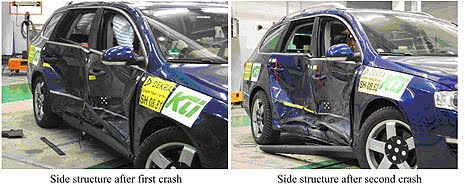
A research project carried out by KTI GmbH & Co in Germany shows that improperly repairing collision damage, especially in newer vehicles constructed with high tech materials, will lead to an unsafe vehicle in subsequent collisions.
In a research paper presented in June at the 22nd International Technical Conference on the Enhanced Safety of Vehicles in Washington D.C., KTI detailed the results of its effort to objectively quantify the influence of non-professional repairs on the behavior of a car's body structure in a subsequent crash.
KTI, with the support of Volkswagen, subjected a 2005 VW Passat to two separate side impact crash tests; one on the undamaged car having never been repaired, and a second crash test after repairing the car using only "traditional" repair methods. According to KTI, the repair methods conformed to a typical repair standard carried out about 10 years ago, as if done today in a body shop with no information about the correct way to repair this particular car and without the correct tools or welding machines for the high-strength steels.
The body structure of late-model vehicles is typically made up of a number of modern steels. With a side impact at 30 mph (the 50 km/h Euro NCAP standard) it was shown that a non-professional repair compromises the protection afforded by the original body structure. The specific results of the KTI test showed more than two inches of additional intrusion into the passenger compartment, increased damage to adjacent sections of the vehicle, and the failure of the side curtain airbag.
The Set Up
Following a first side impact crash of the original car using the Euro NCAP procedure, the repair of the damage caused by the first crash was carried out using traditional repair methods and older equipment that, today, would be considered a non-professional repair, no matter how competently those traditional repair methods may have been performed. Finally, differences in deformation behavior between the two crashes were analyzed to determine the implications for passenger safety.
The Passat was chosen for the tests because its structure represented a state of the art car body with several high-strength and ultra high-strength steels with one of the highest torsional stiffness values (about 30,000 Nm/°) in its segment. Also, KTI said it chose to test the side of the car because only small changes in intrusion distance can present a higher risk for the occupants than in frontal or rear-end impacts at similar speed.
The damaged car was repaired with an older spot welding machine with fixed pressure and 6.4 kA maximum current. For this repair, the OEM recommends an Inverter type welding machine with 10 kA maximum current and a variable pressure to join the high strength steel safely. The deformed inner sill, made from ultra high strength steel, was re-shaped and partially replaced on a bench then reinstalled using a MAG welding process.
The OEM procedure calls for complete replacement of the B-Pillar and other deformed components constructed with high strength steel. Repairing these components is not acceptable because the structure and strength of the material is severely degraded by welding and reforming.
The Results
After completing the repair, the car was again subjected to an identical side impact crash test.
"It was immediately evident that there was a substantial difference, with far more comprehensive deformation of the car body after the second impact. The B-pillar had noticeably higher intrusion into the passenger compartment in comparison with the first crash, especially at the lower part at the connection with the sill," the report showed.
Measurement of the car body confirmed there was 60 mm (2.3 inches) more intrusion after the second test, compared to the first crash.
Other differences noted by KTI included damage to areas that were unaffected by the initial crash due to the change in load paths caused by the substandard repair. The roof and the transmission tunnel both displayed severe deformation not seen in the first crash, and the top right corner of the windshield was damaged in the second crash.
Perhaps most notable is that in the second crash, the front and rear passenger side airbags and front passenger belt pre-tensioner were correctly deployed, but the passenger side curtain airbag failed to operate.
Source: Collision Week
Tuesday, 5 July 2011
Motor Salvage – The next 10 years
Where will the salvage market be in 10 years time? Don’t know is the honest answer, but allow me to predict that more cars will be removed from use, dismantled and broken; and make at least one recommendation that will benefit all motor salvage and auto recycling businesses.
Why will more vehicles be broken?
Well the continued efforts of manufacturers to reduce vehicle weight will continue, resulting in increased use of different and high strength metals that are more effective in protecting vehicle occupants, but more difficult to repair following an accident.
Manufacturers will continue to ignore the repairability of their vehicles and focus on how to make the vehicle easier to build.
As an example, laser welding is impossible to replicate in a repair situation, but is increasing in use on production lines. This increases the cost of repair and raises the potential that the vehicle will be written-off because repair is not possible.
The increase in the amount of electrical systems on vehicles seems to be gathering pace, so cars that are 5-7 years old in the future will be almost obsolete as new vehicles come on the market with ever better control systems, user interfaces and connectivity. Residual values will drop rapidly, when combined with increased repair cost and lack of demand for older vehicles will mean that more will end up as end of life vehicles.
This could lead to considerable change in the salvage market, less focus on vehicles being repaired will mean that more vehicles will need to be dismantled and recycled.
Meeting various recycling targets will become more difficult, especially as the amount of electrical components in vehicles increases, and more legislation will have to be considered as Authorised Treatment Facilities dispose of waste electrical equipment, .
This is where membership of a strong trade body or salvage association is so important, these organisations can advise and assist their members to prepare and change to meet the new challenges, they can also lobby at government level to ensure legislation is sensible and reasonable, that it does not disadvantage legitimate businesses operating within the law, and they can also work with local and national agencies to force non-compliant and illegal sites to clean up or close.
Support your salvage association, use events to network with other members, discuss the future and what this could mean to you, your business, your family and employees, and then work together to make your business viable for the future.
Why will more vehicles be broken?
Well the continued efforts of manufacturers to reduce vehicle weight will continue, resulting in increased use of different and high strength metals that are more effective in protecting vehicle occupants, but more difficult to repair following an accident.
Manufacturers will continue to ignore the repairability of their vehicles and focus on how to make the vehicle easier to build.
As an example, laser welding is impossible to replicate in a repair situation, but is increasing in use on production lines. This increases the cost of repair and raises the potential that the vehicle will be written-off because repair is not possible.
The increase in the amount of electrical systems on vehicles seems to be gathering pace, so cars that are 5-7 years old in the future will be almost obsolete as new vehicles come on the market with ever better control systems, user interfaces and connectivity. Residual values will drop rapidly, when combined with increased repair cost and lack of demand for older vehicles will mean that more will end up as end of life vehicles.
This could lead to considerable change in the salvage market, less focus on vehicles being repaired will mean that more vehicles will need to be dismantled and recycled.
Meeting various recycling targets will become more difficult, especially as the amount of electrical components in vehicles increases, and more legislation will have to be considered as Authorised Treatment Facilities dispose of waste electrical equipment, .
This is where membership of a strong trade body or salvage association is so important, these organisations can advise and assist their members to prepare and change to meet the new challenges, they can also lobby at government level to ensure legislation is sensible and reasonable, that it does not disadvantage legitimate businesses operating within the law, and they can also work with local and national agencies to force non-compliant and illegal sites to clean up or close.
Support your salvage association, use events to network with other members, discuss the future and what this could mean to you, your business, your family and employees, and then work together to make your business viable for the future.
Subscribe to:
Posts (Atom)