Salvage Wire

Salvage Wire
Helping Automotive recyclers become leaders in their industry

Monday, 16 October 2023

10 years of Salvage Wire

10 years ago I started Salvage Wire following the closure of Bluecycle, the salvage site for the UK’s largest motor insurer, Aviva; if anyone had said to me then that 10 years later I would be travelling the world speaking, training and consulting I would have told them that they were crazy!

My journey started in 1978 when I left school and started an apprenticeship - I always had a love of cars and I wanted to start work as soon as possible so took the apprenticeship route rather than staying at college and university. 

Spent a number of years working in the retail side of the industry and ultimately became After Sales Manager, responsible for service, parts and collision repair and reporting directly to the dealer principal before joining Norwich Union, the UK’s biggest insurer as a vehicle damage assessor.

10 years later I joined Bluecycle which was a wholly owned subsidiary of Aviva (the new name for Norwich Union) as Compliance Manager and spent 13 wonderful years as part of the team that took the company from a start up to a multi-million £ business dealing with all Aviva salvage vehicles and a number of other contracts for salvage. Bluecycle was at the forefront of internet auctions for salvage and changed the marketplace in the UK in a very short space of time.

We were told that Bluecycle was being closed and all our work was being outsourced and this meant that all staff members were out of work - faced with this dilemma I decided to bring Salvage Wire into a going concern.

A few years previously I had spent some time with my sister and she asked me what I would do if I was ever out of work, I had no answer. Over an 18 month period we built a business plan and decided to register Salvage Wire as a company and make it dormant, so if the need arose I could bring it into a going concern. Why Salvage Wire? My sister ran her own company called CAD Wire so it made sense to mirror her company name because we could be part of the same group if the need arose.

We very quickly realised that there was a need in the automotive recycling industry for quality training, especially on high voltage (electric and hybrid) vehicles, so training was written, it was sent off to be accredited and we started to deliver high voltage training that was specifically designed for vehicle dismantling and recycling.

There was a lot of training out there for vehicle repairers, for technicians who diagnose faults, make vehicles safe, repair the faults, put the vehicles back together and make them work again, but nothing for recyclers to assess the vehicles, make them safe, strip the high voltage parts, store and ship the parts. We aimed to fill that gap.


I completed more training for myself and also got accredited to deliver training to vehicle technicians, collision repair centres and mechanical repair shops for a number of organisations, and in 2019 we were approached by TUV Rheinland and asked if we would design their electric and hybrid vehicle training programme, which we did in 2020 - unfortunately a global pandemic made the launch of this programme slightly more difficult.

TUV Rheinland are a certification company who deliver training and certification on a global scale, so over the last few years I have been fortunate enough to travel across the world delivering their training. Salvage Wire now work for the vehicle scrap and recycling industry at one end of the process, for universities, research and development companies and vehicle manufacturers at the other end of the process (so we know what is being designed and will be coming into production in a few years time that will ultimately end up in a salvage or dismantling yard), and everybody in the middle - mechanical repair, collision repair, motorsport, vehicle converters, first responders, boat manufacturers, aeronautical industry and more helping them all to become more competent, have a better understanding and knowledge of high voltage vehicle technology.


We also still do consulting work and event planning, but training and development is the core of our business, and this is where our focus will be for some time as we develop new training, new accreditation and start to deliver globally certified technical, managerial, and leadership training to the vehicle recycling and dismantling industry in the future.

Our global training network is growing, more programmes are being launched, more training is available and Salvage Wire will coordinate all of the training, maintain standards across our training network and give consistent, quality training wherever the client is based with a certification that is recognised globally. 


Looking forward Salvage Wire have more ideas and innovation to bring to the marketplace, and we also want to resurrect some previous ideas that we allowed to drop due to pressure of work and a global pandemic.


Salvage Insight was relaunched recently with a new focus on helping the salvage


industry with ideas, issues or problems they face. Have you ever had an idea but didn’t know, or didn’t have the time to implement it? Talk to us and one of our consultants could assist you to resolve that issue or bring the idea into being. More details at https://www.salvageinsight.co.uk/ where you can book your free one hour consultation.


Depollution podcast was an idea we had during covid, and went really well for around 12 months, but time constraints have meant that it hasn’t been our main focus so this
is something that we want to bring back very soon. Invitations to be a guest on the podcast will come out first - if you receive one please respond quickly so we can get you on the podcast.


I would like to say that I had a business plan that worked - I did have a business plan, but like many this got adapted, changed, scrapped, re-written, adapted, changed, scrapped…. and we are now where we are. What I did learn was never to be too prescriptive and detailed on the business plan and be prepared to try something, fail, learn, change and try again. Never be afraid of failure, use it to learn and move forward.

I have been blessed, I am doing better than I deserve, but I am never satisfied, I always think I can do better, change, improve and develop. But one thing I do know is that my faith has been an integral part of this journey and without my church family, my mentors, the bible and Jesus I would not have got this far - have a look at https://carvauk.co.uk/ for more on how you can be recycled.


Salvage Wire’s mission has always been ‘Helping automotive recyclers become leaders in their industry’ and this remains the case as we move forward into our next 10 years; we want to help the vehicle recycling and salvage industry be recognised globally as a professional, qualified, safe, respected and efficient industry, an industry that can be trusted and become an equal partner with vehicle manufacturers, vehicle repairers, regulators and legislators.


Friday, 2 December 2022

The Life of an EV Trainer

 Cyprus, Spain, Brazil, US, Ireland and Jamaica - just some of the places that electric vehicle technology has taken me so far this year - a life that sounds very glamorous which, in reality, can be the exact opposite.

Don’t get me wrong, this job takes me to places I would never have been to otherwise, puts me in the middle of a amazing communities and people, and  gives the ability to teach about new technology and the future of the automobile; but there are a few downsides, including weeks away from the family, too much time in airports, airplanes and hotels - OK if you like your own company - and lost luggage!

Cyprus - on a British Army base training REME (Royal Electrical and Mechanical Engineers) at the end of March - the UK was getting snowed on and I was in the sunshine.

Spain, likewise, very cold in the UK and pleasantly warm in Spain, training Spanish and Portuguese technicians in English - on-line translation services via a zoom connection are amazing.

Brazil took three flights to get there, again translation services required, but this time with an excellent translator who was with us in person, training at a technical institute with a Prius donated by Toyota that we took the battery out of many, many times - just don’t tell Toyota how many.


USA for training and trade shows - travelling over 2,000 miles whilst across the country.

Ireland. always enjoy travelling to the Emerald Isle - Guinness doesn’t taste the same anywhere else in the world. This time the car was put onto a ferry across the Irish Sea, the only issue is that I live almost as far East as you can get in the UK and the ferry ports to Ireland are on the west coast. Travelling home I board a ferry that gets me into the UK around 1am and I have a 6-7 hour journey across country to home - the benefit at that time of night is the traffic volumes are extremely low. 

And finally to Jamaica - three flights to get there, six hour delay in Miami and no luggage when I got to Kingston - so no tools or PPE for the first two days of training meant quite a bit of improvisation was required, along with a trip to the shops for some clothes and toiletries.


All of this pales into insignificance when you look at the impact of EV training for each of the candidates. In Jamaica all of the candidates were trained to level 3 and also given train the trainer competency, so they can now go out and train another 200 technicians and 200 first responders as Jamaica ramp up their adoption of electric vehicles. The British Army are bringing cleaner vehicles into their fleet and the engineers have to keep them running, dismantlers in Ireland are probably amongst the best trained in the global industry as the Electric Elves programme gives them training at no cost, and I know that the guys in Brazil have taken what they learnt and are now sharing this knowledge with many other candidates in the country.

Everyone who received the training learnt about the new technology, how it works, the benefits it brings to the climate, reduced CO2 emissions and cheaper running costs, as well as how to stay safe when inspections, diagnosing, assessing, transporting or working on these vehicles, and all are better prepared for this revolution in how we run and power our vehicles in the future.

Sounds like fun? Well, come and join us, we are looking for EV trainers who want to travel to customers in their own country or travel the world, for more information contact training@salvagewire.com and send us your CV.

Friday, 8 July 2022

Best Management Practice for Electric Vehicles

 Visited a vehicle repairer recently for a pre-arranged training day and was amazed as two of the candidates refused to start the training, one said that he didn’t want to do the training and the other claimed he was too busy. Even more amazingly, the business owner accepted this and allowed them to not complete the training!


The training went ahead with the remaining candidates and it was soon apparent that this repairer did not have any best management practices in place, and any processes that were written down were only there to satisfy business requirements and audits and were, in reality, largely ignored during day to day operations.

When you are dealing with high voltage vehicles this lack of leadership is very worrying, especially with the risks that these vehicles carry, and part of my role as a trainer is to highlight the need for senior people in the business to take responsibility for the safety of themselves, their colleagues and the business; well written and consistently followed best management practices are essential, especially where high voltage vehicles are concerned.


When building a best management practice for high voltage vehicles there are four stages to consider, these are:

  • Vehicle collection/delivery
  • Vehicle receipt and assessment
  • Vehicle Depollution and dismantling
  • Parts storage and shipping


We also need to outline the levels of training required, which are:

  • Electric Vehicle Informed Person (EVIP) - vehicle purchase, senior management, health and safety specialists, parts and shipping
  • Electric Vehicle Competent Person (EVCP)- dismantling and vehicle collection
  • Electric Vehicle Authorised Person (EVAP) - technician assessing condition, powering down and removing HV battery
  • Senior Electric Vehicle Authorised Person (SEVAP) - senior technician who may strip HV battery


Vehicle collection

Where is the vehicle coming from, has it already been made safe, are there any special instructions or detailed information that the collection driver needs to be aware of. Equally, if the driver is given any specific instructions about the vehicle when it is picked up are these given to the receiving yard?  

The driver will need to assess the vehicle prior to loading it onto the truck, 

  • Is the battery damaged?
  • Is there any risk the battery may catch fire during transportation?
  • Does the vehicle need to be made safe prior to loading?


Collection drivers training should be equivalent to EVCP with specific training for vehicle recovery or towing


Vehicle receipt and assessment

Who is responsible for receipt of the vehicle, are they qualified and do they have appropriate personal protective equipment?

High voltage vehicles should be parked in a designated area until they have been assessed and powered down?

During the assessment the operator needs to determine the condition and health of the battery, is it suitable for re-sale and re-use, should it go into second use as a stationary storage device or it is only suitable for recycling? 

The vehicle should then be powered down and made safe prior to depollution and dismantling. All of this is ‘live’ work and needs to be completed by a suitably qualified and experienced person - probably an Electric Vehicle Authorised Person


Vehicle Depollution and dismantling

When powered down, or made safe, high voltage vehicles have stored energy that is constrained within the high voltage battery, meaning that the rest of the vehicle can be depolluted and dismantled by suitably trained technicians, minimum of EVCP qualified.

Removing the battery becomes an EVAP operation because of the energy stored within this component.

Some vehicle dismantlers may want to further dismantle the HV battery down to individual modules, and this is SEVAP competency.


Parts storage, sales and shipping

High voltage parts, excluding the HV battery, can be stored in normal parts storage areas as the risk posed by these is no greater than any other component, the HV batteries are a completely different prospect, and you will need a specific storage area with restricted access.

  • Battery chemistry must be kept separate; 
  • batteries need to be secure so they cannot fall or have anything fall on them;
  • keep them dry; 
  • do not stack and follow manual handling processes due to the weight of these components;
  • when shipping these components follow all rules and regulations that apply in the area you are operating as these components are considered to be dangerous or hazardous goods in almost all jurisdictions.


Whoever is responsible for battery storage, sales and shipping must be trained and qualified appropriately, and this will almost certainly be different to the training and qualification that is required for a vehicle dismantler or technician.


Everyone dealing with these vehicles needs to be trained to the appropriate level, and also be equipped with all necessary high voltage personal protective equipment and tools, including, but not limited to:

  • High Voltage Gloves
  • Insulated safety shoes
  • Face/eye protection
  • Safety rescue hook
  • Cat3, 1000v Multimeter
  • High Voltage hand tools
  • Warning signs


The list above is not exhaustive and there could be additional elements that need to be considered, but it is incumbent on all businesses to put steps in place to keep their employees safe, build best management practices, use them, and also when scheduling training make certain all the staff involved know what is happening, when and why their involvement is essential!


If any business would like help to design and build their own best management practice for high voltage vehicles then please contact Andy Latham at Salvage Wire (andy@salvagewire.com).


Saturday, 2 July 2022

JAMAICA

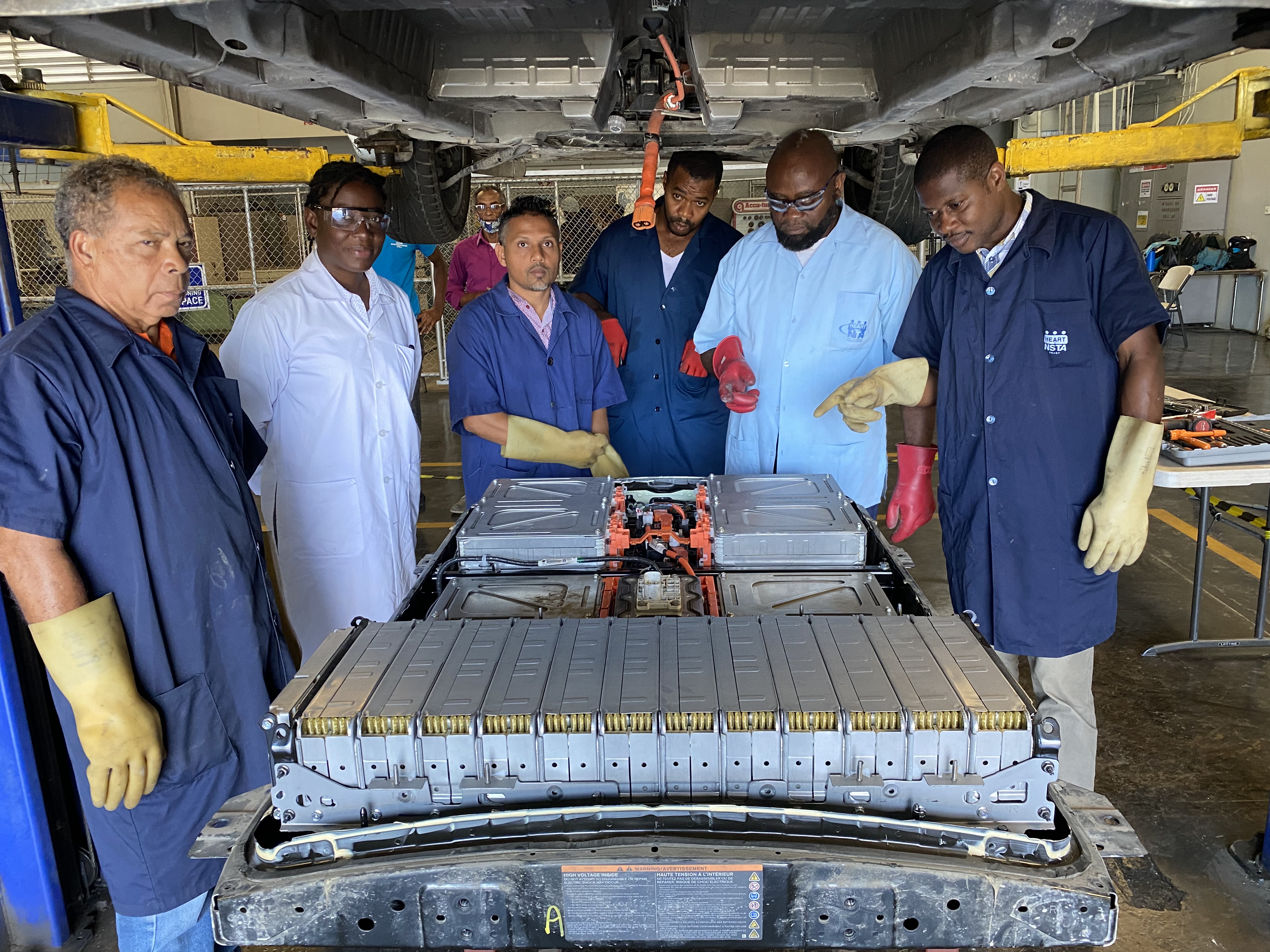
It has been a privilege and an honour to be part of the e-drive initiative in Jamaica - training vehicle technicians on electric and hybrid vehicle technology, maintenance and hazard management.

15 technicians are now qualified to IMI Level 3 standard and will be leading the charge as a further 200 technicians and 200 first responders are trained and educated on this technology - all part of the drive to electrify the vehicle fleet in Jamaica over the coming years.


Jamaica is a beautiful country, once out of the city centre or tourist hot spot you are met with a lush, tropical countryside that is largely unspoilt, and some of the beaches need to be seen to be believed - they are stunning with the Caribbean Sea lapping at the shore.

The people are also extremely welcoming and largely very friendly - there is an image of Jamaica being a hot spot for crime, and yes there is a risk of trouble particularly if you are in the wrong area or out at night - but this is little different to other parts of the world, and if you take sensible precautions then you will stay safe.

Driving standards, and the quality of the roads, is generally appalling - I am never going to complain about driving standards or road quality in the UK again (that statement may change on the drive home from Gatwick!) traffic lights just change colour - most taxi drivers and motorcyclists seem to ignore them - overtaking traffic queues, jumping in front of other drivers, tailgating and changing your mind at the last second are normal practices - and if the horn on the vehicle ever failed then this would make the vehicle completely un-driveable - the Jamaicans live with a finger always on the horn button and everywhere you are the sound of vehicle horn is a constant! I saw many vehicles with broken lamps, dented panels and missing bumpers, I was quite surprised not to see many accidents considering how they drive and how busy the roads are in Kingston.

The roads are generally of very poor quality, lots of potholes big enough to damage wheels, tyres and suspension are the norm, poor quality road surfaces and very little drainage so in wet weather there is standing water in many places.

The vehicles on the road are also interesting, lots of Japanese brands are present and many vehicles are Japanese imports (all RHD models) with some of the weird and wonderful models that the Japanese love - one of the most common is the Toyota Probox - a small five door station wagon (estate) type vehicle that is favoured by the many taxi drivers - and more often to be seen with 5 or 6 passengers spread out across the two rows of seats.

There are some prestige models, saw a variety of Mercedes, BMW, Land Rover/Range Rovers, many pick-up trucks and a good presence from Hyundai/Kia, but very little else other than Toyota, Honda, Nissan, Mazda and Subaru.

One surprise was seeing previously UK registered vehicles on the island, these were very obvious because the UK number plates were still on the vehicle and covered over with Jamaican registration plates.


There are some electric and hybrid vehicles around, mainly Toyota models but did see two Nissan Leaf and a BYD full EV - numbers of electric vehicles are currently very low but the ambition of the project I was involved with is to increase these significantly year on year.

Brand new electric vehicles are very costly, so many will come into the country as second hand imports (as many of their current vehicles do now), and one question was raised about the shipment of these vehicles from other countries and the time this takes - sometimes two or three months at sea. 

The vehicle manufacturers have plenty of experience shipping brand new electric vehicles around the world, but how do we safely ship previously used vehicles and not damage the battery by leaving it unused too long?

Looking at vehicle manufacturer data we determined the following for long-term storage - defined by vehicle manufacturers as being more than 30 days without use.

  • The battery needs to be between 30 and 50% charged
  • Battery state of charge needs to be monitored periodically - one manufacturer stated every four weeks, another every six weeks - and charged if the level drops below 20% state of charge
  • Some differences on the 12v battery, one manufacturer advised that the 12v battery should be disconnected to reduce load, another stated that the 12v battery should remain connected so the battery state of charge could be monitored.
  • All manufacturer data reviewed mentioned ambient temperature for storage - some specifying minimum and maximum temperatures, others stating that the vehicle should not be allowed to get hot and should be stored at ambient temperature. Figures of -10c and +30c were mentioned as limits by one manufacturer.

In summary, Jamaica may be late to the party on electric vehicles but they are catching up fast and using the knowledge that China, the EU and North America have developed over the last 24 years to make certain they adapt quickly for this new technology. There are some challenges though, including:

  • Road quality
  • Driving standards
  • Awareness and understanding of electric and hybrid vehicles
  • The possible damage long term shipping may have to the HV equipment on pre-used vehicles from other countries.

Some of these issues need intervention from the Jamaican authorities; as an industry we can help with:

  • Sourcing pre-used RHD vehicles
  • Helping with the supply of pre-used parts, particularly suspension, steering, lamps and bolt on body panels - could a UK vehicle dismantler set up a partnership with a Jamaican used parts company?
  • Investigating the implications of putting an EV on a ship for two months,  how this could degrade the HV battery and what could be done to reduce this impact.


Thanks must go to Heart NSTA Trust, Green Solutions International, IDB Labs and JPS Foundation in Jamaica and Eintac in the UK - without all of these this project would not have been possible.

EINTAC  - Use discount code ES10 for 10% discount off all orders

Heart NSTA Trust 

JPS Foundation 

IDB Labs 

Project E-Drive

Friday, 23 October 2020

Ban on Internal Combustion Engines from 2030, 2032, 2035….. how will we cope?????

 Difficult one this, but is definitely a subject that needs to be spoken about. We have 10-12 years to get this right and this includes a number of factors:


This does not mean that fossil fuels will be ‘switched off’ in 12-15 years time, it is just that new ICE vehicles cannot be sold, so if the ban comes into force at the start of 2035 then the ICE vehicles sold in 2034 will still be in use for another 12-15 years.


ICE vehicles and the fuel, will be taxed VERY heavily to drive them out of use as quickly as possible.

Road charging and road tolls will become much more commonplace to back-fill the loss of revenue from fossil fuels


Used vehicle supply - the Nissan Leaf has been around for 8 years now, useable ones are available at sensible money for those that cannot afford a brand new vehicle. There is a massive influx of new ‘zero emission’ vehicles coming onto the market over the next 24 months, so as we move towards 2030 a significant number of used vehicles will be available giving lots of choice at all price points and keeping those on low wages mobile.


Electric vehicles WILL NOT be the only solution, hydrogen powered vehicles will also be available - the problem here is the infrastructure to refuel these vehicles. Traditional ‘oil’ companies can lead the way here by back-filling the reduction of fossil fuel sales by producing hydrogen ‘on-site’; and dispensing it at source. I believe that hydrogen will become the choice of many heavy vehicles and long distance travellers with electric being the choice for lower mileage users.


Look at how you use your vehicles, do you drive more than 50 miles per day? Many do not! The vast majority of new electric vehicles have 180-280 miles of range, so do they need to be re-charged every night?


A lot of very intelligent people are researching the power supply system and providing, or suggesting alternative solutions. One example is vehicle to grid. You arrive home in our electric vehicle and have around 30% range left, you plug into your smart home charger, and the grid

can take a small amount of power out of your vehicle at peak demand time (1KWh is about 4-5 miles of range) and pay you for that energy. Overnight your electric car is then recharged using clean, renewable energy and it is ready to go the following morning.


One of the best bits of advice I saw recently came from an electrical engineer to school leavers - his advice was to train as an electrical engineer as this will be an industry that is currently growing and will expand massively in the next few years as they pivot towards the new future. They have 10 years to get it right!


Don’t forget, this is not just the automotive industry, but commercial heating, domestic hot water, heating and more will all be forced to move towards a zero emission future, so this demands a fundamental rethink of how we use power, where it comes from, and how to reduce CO2 emissions


Vehicle recycling will remain an integral part of the automotive industry, it will evolve and change, develop and grow as the vehicles change and the value base gradually alters from fossil fuel vehicles towards zero emission. How we deal with high voltage batteries in 2030 will be very different to how we deal with those components today!


Monday, 5 October 2020

Management of Electric Vehicles in the Collision Repair Industry

It is time for leaders and influencers in the automotive industry to stand up and raise the profile of leadership; focusing on leadership skills and development of these skills is possibly more important than technical skills and training for the shop staff. Skills will reflect in improved staff performance, staff retention, efficiency, safety, profitability, and much more.


There are excellent collision repair centres out there; the truly exceptional are probably the top 10%, unfortunately, I do not work with these every single day! However, whilst training collision repair centres to Level 3 standard in electric and hybrid technology I do see failures in leadership, management and delegation, and if what I see in this area of the business is reflected across the rest of the company, then heaven help them!
This is just one example of a collision repair centre in the UK that I experienced recently. 
  • High voltage PPE shared with the mechanical repair centre next door.
  • No high voltage tools at all

  • Technicians didn’t know who their first aider was and believed that they didn’t have a first aid trained person in their department
  • Belief that EVERY high voltage vehicle had to be disconnected no matter what was being done on the vehicle.
  • No system to lock out HV disconnect devices to prevent untrained or unauthorised reconnection of the vehicle, citing “what if we need to move the vehicle from panel shop to paint shop” as an excuse.
  • No equipment to move an isolated vehicle around the business.
  • No training or PPE for vehicle damage assessors - normally amongst the first person to go ‘hands on’ the vehicle.
  • No system of identifying high voltage vehicles in the compound or in the workshop (warning signs or similar).
  • Complete failure to identify high voltage responsibilities across the business - who is allowed to do what to a high voltage vehicle!
  • No understanding of the additional fire risks that high voltage batteries bring
Who is responsible for safety? Everyone is! Each person plays a part in the safety of any company. It could be four technicians sat around a table at break-time to share ideas to stop themselves from getting hurt, or a corporation of five thousand where safety is established in the boardroom and cascaded down. 
  • Tools and PPE - do not share and get your own - this is especially important in the light of Covid-19 and sharing of high voltage gloves and saves the issue experienced when completing the HV training where the tools and PPE kit was in use elsewhere in the business when the practical assessment section of the training needed to be completed. Many collision repair centres do not understand the importance of correct refitting of high voltage components and the need to make certain everything is connected correctly, and where bolts or nuts have been removed that these are tightened to the correct torque.

    Over-tightening can damage connections or terminals and any damage could result in increased resistance in the high voltage system - increased resistance will result in an increase in heat which could result in a fire. An insulated torque wrench is an essential part of any high voltage technicians tool kit along with full details of torque settings for all bolts or nuts that may have been disturbed during the work.
  • First Aider - have a number within each department so there is cover if someone is away from the business and constantly train and refresh the knowledge. 
  • Training and awareness of electric and hybrid vehicles should be compulsory for all staff and not restricted to just the technicians, this way the management team can understand and assess risk, build processes and protocols, assign responsibilities and make certain that the correct tools and equipment are available for everyone.

I Bring You Fire!

 “I am the god of hellfire! And I bring you Fire”, this is the opening line of the 1968 chart hit Fire by The Crazy World of Arthur Brown (listen to it on your streaming platform). A bit later in the song you find the lyrics “Fire, to destroy all you’ve done. Fire, to end all you’ve become.” Lyrics that could perfectly describe the crazy world of a small number of automotive recycling businesses that don’t have any fire prevention plans in place.


Vehicle Fire Blankets can form an important part of any vehicle recyclers fire prevention plan, as a fire in any vehicle can be suppressed by one of these blankets very quickly and safely. The blankets limit damage to adjacent vehicles or buildings, the need for any water is eradicated and the interruption to the business is massively reduced.


High voltage vehicles are no more likely to catch fire than conventional vehicles, but the blaze could be much more severe if they are ignited.

There are a number of reasons for these fires, including:

  • External Factors - something else causes a fire
  • Incorrect Handling - poor storage of vehicle or battery
  • External Damage - due to an accident or incident
  • Overcharging or deep discharging
  • Internal fault in battery or vehicle


High Voltage batteries can burn at very high temperatures, release highly toxic substances and require extreme volumes of water to put out and cool down. Fire services I work with are advising a requirement for 10,000 litres of water (approx 2,500 gallons) for a single electric vehicle fire - the majority of this water is required to keep the battery cool after the fire has been stopped because there is a risk that the battery will re-ignite if it hasn’t been cooled down sufficiently. Just imagine your own yard; can the drains or interceptor tank cope with 10,000 litres of contaminated water running off the yard in a very short space of time?


In tests temperatures between 700 and 1000 C have been recorded when an electric vehicle battery has been on fire - you can only imagine the effect of this type of conflagration in a vehicle recycling yard or workshop, so updated fire prevention plans are essential for all vehicle recycling and dismantling facilities to factor in high voltage vehicles and their components, and Vehicle Fire Blankets can be integral in these plans, for example.


Consider using a vehicle fire blanket over the vehicle whilst on the transporter so if the vehicle does catch fire during delivery the resulting damage may be reduced


You do not know what condition the vehicle is in as it arrives in the yard, it may catch fire overnight so put the vehicle in a quarantined area with a clear 5 meters (15 feet) of open space around it until it can be dismantled - this is to ensure that if a fire occurs the vehicle will not create additional damage to surrounding vehicles or buildings. Alternatively, deploy a vehicle fire blanket over the vehicle so it is quarantined without the need for lots of space. 


Have fire blankets available for quick response so if any vehicle catches fire the blanket can be deployed swiftly and safely and a major fire will be avoided.


Consistently train and practice using these blankets so everyone in the business knows what to do if a fire is detected.


In the Crazy World of Arthur Brown “You’re gonna burn”; in our world we have plans in place so that we don’t burn, and if the worst case scenario does happen then the damage will not destroy all that we have built!


For more details on car fire blanket look at http://carfireblanket.ie , to purchase contact

info@salvagewire.com and for a best management practice on electric and hybrid vehicles refer to http://motorsalvage.blogspot.com/2020/05/electric-and-hybrid-vehicle-best.html